
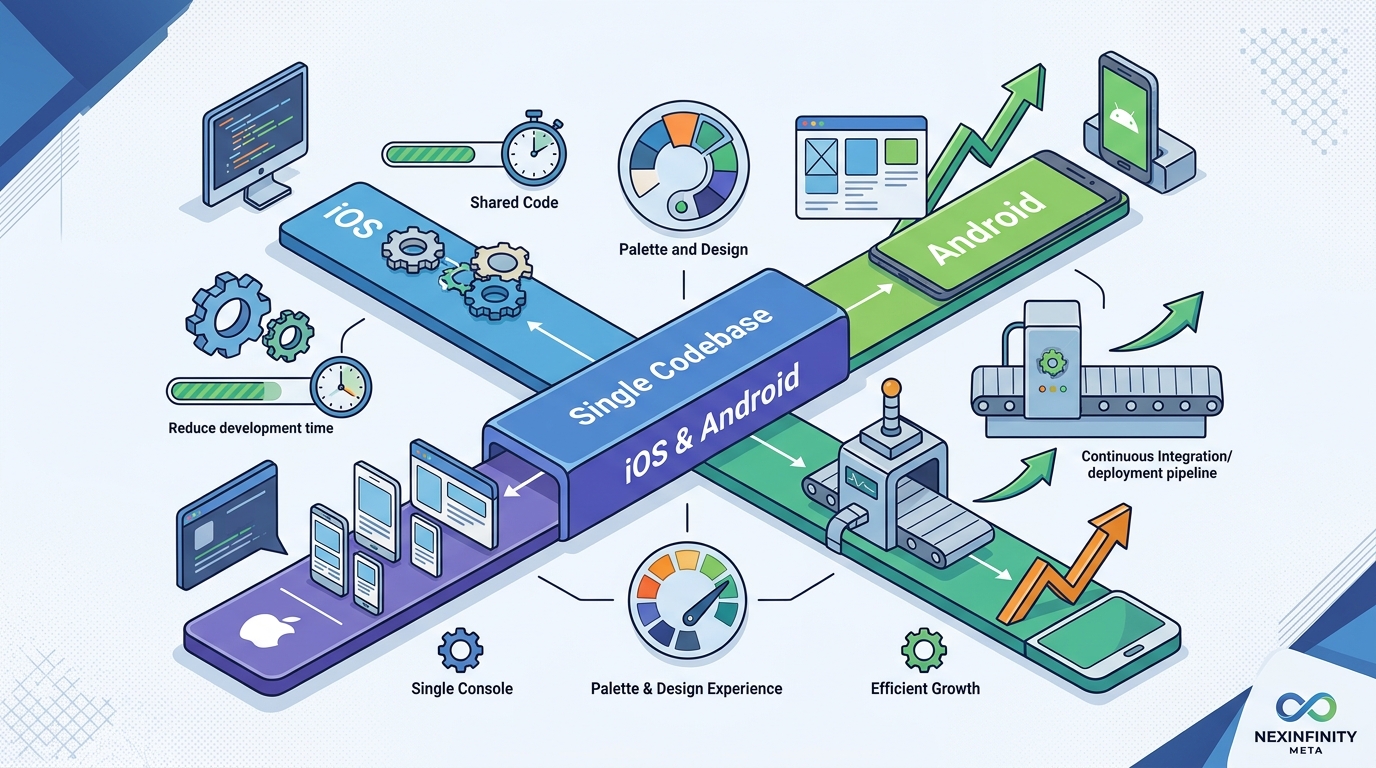
Building a mobile app used to mean hiring two separate teams, writing two separate codebases, and managing two separate release cycles. That reality is changing fast. Cross-platform development is a software approach that lets developers write one set of code and deploy it to both iOS and Android simultaneously. With frameworks like Flutter, React Native, and .NET MAUI maturing rapidly, businesses of all sizes are choosing a single codebase strategy to ship faster, spend less, and reach more users. Below, we break down the seven most compelling benefits of this approach and explain when it makes the most sense for your next project.
1. Significant Cost Savings
Budget is often the deciding factor for startups and mid-size companies. When you build natively for both platforms, you pay for two development teams, two QA pipelines, and two ongoing maintenance contracts. A single codebase eliminates most of that duplication.
According to Newly's 2025 cross-platform guide, this approach typically saves 30 to 50 percent in development costs compared to maintaining separate native codebases. Those savings free up budget for professional UI/UX design or post-launch digital marketing campaigns.
2. Faster Time to Market
Speed is a competitive advantage. Cross-platform frameworks reduce development time by roughly 30 percent on average, according to DECODE's framework analysis. Because developers write code once and deploy it across platforms, teams avoid duplicating work entirely.
This means you can launch on both iOS and Android simultaneously rather than staggering releases. For businesses racing to validate an MVP, that speed can make or break market traction.
3. Consistent User Experience
A unified codebase is a single source of truth for your app's behavior, layout, and interactions. Native development sometimes results in slightly different designs and functions between platforms, which can confuse users and dilute your brand.
Cross-platform development delivers a consistent user experience across different platforms, making it easier to maintain brand coherence. When your design system lives in one place, every screen on Android matches every screen on iOS. Teams offering end-to-end mobile app development can enforce this consistency from wireframe to deployment.
4. Simplified Maintenance and Updates
After launch, maintenance is where hidden costs pile up. With two native apps, every bug fix, security patch, and feature release has to be implemented and tested twice. A single codebase cuts that workload in half.
Updates and new features can be deployed to both platforms at once, reducing the risk of version drift. Pair this with a reliable cloud infrastructure partner, and your CI/CD pipeline stays lean.
Easier QA and Testing
One codebase means one test suite covering the majority of your logic. Platform-specific edge cases still require attention, but the overall QA burden shrinks dramatically.
5. Wider Audience Reach from Day One
Launching on a single platform means leaving roughly half of the mobile market on the table. Cross-platform development lets you target both iOS and Android users from day one, maximizing your reach without doubling your investment.
This is especially valuable for SaaS products that need mobile companion apps. If you are building a custom SaaS product, offering a cross-platform mobile app alongside your web dashboard creates a seamless ecosystem for your users.
6. High Code Reusability
Code reusability is the percentage of source code that can be shared across platforms without modification. Modern cross-platform frameworks allow teams to share 70 to 95 percent of code between platforms, including business logic, API calls, state management, and much of the UI layer.
As Kotlin's official documentation explains, using a single codebase allows developers to cut down on time spent doing repetitive tasks such as API calls, data storage, and analytics implementation.
| Factor | Native (Two Codebases) | Cross-Platform (Single Codebase) |
|---|---|---|
| Code Sharing | 0% | 70 to 95% |
| Development Cost | Higher (2x teams) | 30 to 50% lower |
| Time to Market | Longer (sequential or parallel) | ~30% faster |
| Maintenance Effort | Duplicate bug fixes | Single fix, dual deploy |
| UI Consistency | Platform-specific variance | Unified design system |
| Performance | Fully native | Near-native (framework dependent) |
7. Access to Mature, Modern Frameworks
The technology ecosystem for cross-platform development has matured rapidly. Here are the leading options in 2025:
Flutter
Flutter is Google's open-source UI toolkit for building natively compiled applications from a single codebase. It offers expressive, flexible designs and near-native performance, making it a top choice for visually rich apps.
React Native
React Native is Meta's JavaScript-based framework for building mobile apps using React components. Its strong community and support for native modules make it ideal for scalable applications.
.NET MAUI
.NET MAUI is Microsoft's evolution of Xamarin that enables developers to build apps for Android, iOS, macOS, and Windows from a single .NET codebase. Teams already in the Microsoft ecosystem find it a natural fit.
Choosing the right framework depends on your team's skills, performance requirements, and long-term roadmap. A full-service web and app development partner can help you evaluate trade-offs and pick the best stack.
Key Takeaways
- A single codebase for iOS and Android can reduce development costs by 30 to 50 percent.
- Cross-platform frameworks cut average development time by about 30 percent.
- You can share 70 to 95 percent of code across platforms, including business logic and UI.
- Unified codebases deliver consistent user experiences and simplify QA.
- Maintenance and updates deploy once to both platforms, reducing version drift.
- Flutter, React Native, and .NET MAUI are the leading frameworks in 2025.
- Cross-platform is ideal for MVPs, SaaS companion apps, and budget-conscious launches.
Frequently Asked Questions
What is cross-platform mobile app development?
Cross-platform mobile app development is the practice of building mobile applications that run on multiple operating systems, primarily iOS and Android, from a single codebase. Instead of writing separate apps in Swift and Kotlin, developers write code once and deploy it everywhere.
How much money can a single codebase save?
Businesses typically save 30 to 50 percent in development costs compared to building and maintaining two separate native apps. The exact savings depend on app complexity and team size.
Does cross-platform mean lower performance?
Not necessarily. Modern frameworks like Flutter deliver near-native performance for most use cases. Apps with heavy 3D graphics or deep hardware integration may still benefit from fully native development.
Which cross-platform framework is best in 2025?
Flutter and React Native remain the most popular choices. Flutter excels in UI-rich applications, while React Native is preferred by teams with JavaScript expertise. .NET MAUI is strong for enterprises in the Microsoft ecosystem.
Can I still access native device features?
Yes. All major cross-platform frameworks provide mechanisms to call platform-specific APIs when needed. You can access cameras, GPS, biometrics, and other native features through plugins or native modules.
Is cross-platform good for MVP development?
Absolutely. For businesses looking to build an MVP, cross-platform development can be a game-changer because it lets you validate your idea on both platforms at a fraction of the cost and timeline.
How does a single codebase affect long-term maintenance?
It simplifies maintenance significantly. Bug fixes, security patches, and feature updates are applied once and deployed to both platforms, reducing the risk of inconsistencies between your iOS and Android versions.
Ready to Build Your Cross-Platform App?
Whether you are launching an MVP or scaling a SaaS product, a single codebase strategy can save you time, money, and complexity. NEXINFINITY META delivers end-to-end mobile app development from Chennai, India, with AI-accelerated workflows and one in-house team handling design, engineering, and growth. Get in touch today to discuss your project and get a free consultation.