
Adding artificial intelligence to a custom SaaS product is no longer optional. With 76% of SaaS companies integrating AI by 2026, the question is not whether you should add intelligence to your platform but how to do it well. From predictive analytics to natural language processing, AI features can reduce churn, automate workflows, and deliver personalized experiences your users expect. This guide walks you through the practical steps, common approaches, and key decisions involved in embedding AI into your existing or new custom SaaS product.
1. Define the Right AI Use Case
AI integration is the process of embedding machine learning models, language models, or intelligent automation into an existing software system to enhance its capabilities. The most important first step is selecting a use case where AI delivers clear, measurable value rather than adding it for novelty.
Common high-impact use cases for SaaS products include:
- Predictive analytics for churn prediction or demand forecasting
- NLP-powered chatbots for automated customer support
- Recommendation engines for personalized content or product suggestions
- Intelligent document processing for data extraction and classification
Start by identifying where human intervention is currently a bottleneck in your product. As noted in industry analysis, areas like support, sales outreach, and content operations are the most common starting points. Pair this with a review of your UI/UX design to ensure AI features feel natural to end users.
2. Choose Your Integration Approach
You have three primary paths for adding AI to a SaaS product. The right choice depends on your timeline, budget, and how differentiated the AI needs to be.
| Approach | Best For | Timeline | Cost Range |
|---|---|---|---|
| Third-party APIs (OpenAI, Google Cloud AI, AWS Bedrock) | Fast time-to-market, standard tasks | 2-4 weeks | Low to moderate |
| Pre-built plug-ins and embeddings | Adding specific capabilities like sentiment analysis | 3-6 weeks | Moderate |
| Custom ML models | Proprietary data advantages, unique workflows | 3-6 months | High ($50K+) |
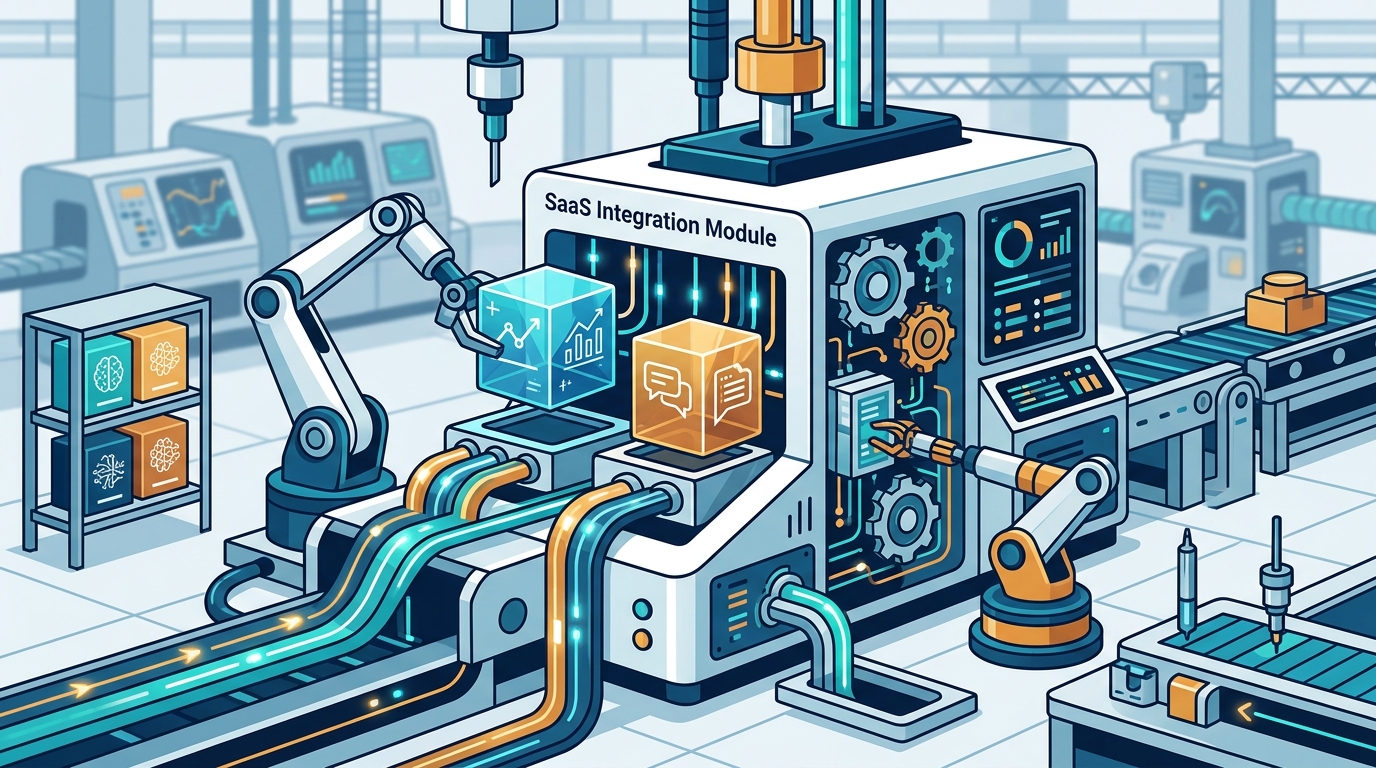
An AI-enabled app is a traditional SaaS platform that incorporates AI features to enhance functionality, such as automation, recommendations, or predictive insights. For most teams, starting with third-party APIs and graduating to custom models after proving product-market fit is the lowest-risk strategy.
When to Use APIs vs. Custom Models
If your competitive advantage comes from unique data, invest in custom models. If speed matters more than differentiation, APIs from providers like OpenAI or Google Vertex AI will get you to market faster. Many successful SaaS products use a hybrid: APIs for general tasks and fine-tuned models for core features.
3. Prepare Your Data Pipeline
Data preparation is the most time-consuming phase of AI integration, yet it determines model accuracy. Start by collecting relevant data from your SaaS application, user interactions, and internal databases. Clean the data by removing duplicates, correcting errors, and handling missing values.
Key Data Considerations
- Ensure sufficient volume and variety for your chosen model
- Implement proper data labeling if using supervised learning
- Set up real-time data pipelines for features that require live predictions
- Store data securely, respecting privacy regulations like GDPR
Your cloud infrastructure must support the compute and storage demands of AI workloads. Scalable cloud platforms like AWS, GCP, or Azure are standard choices.
4. Design a Modular Architecture
A modular architecture is a software design pattern where AI components are built as independent, swappable services rather than tightly coupled into the main codebase. This approach simplifies scaling, testing, and upgrading individual AI features without disrupting your entire platform.
Recommended Patterns
- Microservices: Deploy each AI capability (e.g., NLP, recommendation, anomaly detection) as its own service
- API gateway: Route requests through a central gateway for rate limiting, logging, and versioning
- Feature flags: Roll out AI features gradually to specific user segments
This is especially important for web application development where frontend and backend teams need to iterate independently. A well-designed architecture also makes it easier to swap out models as better ones become available.
5. Build, Test, and Iterate
When building your MVP, focus on the most important AI features first. Perfect and test these, then release to a select group of users. Collect feedback, make improvements, and continue refining. Most strong AI SaaS products become valuable through repeated refinement, not through a perfect first launch.
Testing Essentials
QA for AI features goes beyond standard software testing. You need:
- Unit testing to verify each component functions correctly
- Integration testing to ensure third-party AI services work with your app
- Bias auditing to detect and correct unfair model outputs
- Performance monitoring to track latency, accuracy, and cost per inference
Teams that review usage weekly and optimize bottlenecks learn faster than teams chasing new features without understanding user behavior. Ship with usage analytics and error logging from day one.
6. Address Governance and Compliance
As adoption of AI-enabled apps accelerates, risks around data exposure, compliance, and shadow AI grow. Strong AI governance frameworks are now critical for any SaaS product handling user data.
Key governance steps include:
- Document how AI models make decisions (explainability)
- Implement role-based access controls for AI training data
- Comply with industry-specific regulations (HIPAA, SOC 2, GDPR)
- Monitor for model drift and retrain on a regular schedule
Regulatory compliance is expensive to achieve but creates a barrier competitors must match, making it a genuine competitive moat. Working with an experienced AI integration partner can accelerate compliance while reducing risk.
Key Takeaways
- Start with a validated business pain point, not AI hype. Choose use cases where AI delivers measurable ROI.
- Use third-party APIs for speed; build custom models only after proving product-market fit.
- Data quality determines AI quality. Invest heavily in data preparation and pipeline infrastructure.
- Design modular, microservices-based architectures so AI features can be updated independently.
- Test for bias, accuracy, and performance from the earliest stages of development.
- Implement AI governance and compliance frameworks before scaling to production users.
- Iterate constantly. The best AI SaaS products improve through weekly usage review and refinement.
Frequently Asked Questions
What is the easiest way to add AI to an existing SaaS product?
The fastest path is integrating third-party AI APIs such as OpenAI, Google Cloud AI, or AWS Bedrock. These provide pre-trained models for tasks like text generation, image recognition, and predictive analytics, letting you add AI features in as little as two to four weeks.
How much does it cost to integrate AI into a SaaS product?
Costs vary widely. API-based integration can start at a few hundred dollars per month in usage fees. Custom model development typically ranges from $50,000 to $500,000 depending on complexity, team size, and data requirements. An MVP built with a development partner can cost $15,000 to $80,000 over 6 to 10 weeks.
What AI features are most valuable for SaaS users?
Predictive analytics, AI-powered personalization, automated customer support via NLP chatbots, and intelligent recommendations are among the highest-impact features. These directly improve user engagement, reduce churn, and increase revenue.
Should I build AI in-house or hire a development partner?
For early-stage products, a development partner gets you to market 3 to 4 times faster at a fraction of the cost. Building in-house from day one can cost $200,000 to $500,000 per year in engineering salaries before you know if the product has traction. Consider partnering with an end-to-end team like NEXINFINITY META that handles design, engineering, and AI integration under one roof.
What is the difference between AI-enabled and AI-native SaaS?
An AI-enabled SaaS product is a traditional platform with AI features added on top. An AI-native app is built with artificial intelligence at its core, enabling it to analyze data, make decisions, and execute tasks autonomously. Most existing products start as AI-enabled and evolve toward AI-native over time.
How do I ensure my AI features are compliant with data regulations?
Implement data encryption, role-based access controls, and model explainability documentation. Ensure compliance with relevant standards like GDPR, HIPAA, or SOC 2 depending on your industry. Regular audits and working with experienced compliance-aware development teams reduce risk significantly.
How long does it take to integrate AI into a SaaS product?
Simple API-based integrations can take 2 to 4 weeks. More complex custom model development and training may require 3 to 6 months. The timeline depends on data readiness, use case complexity, and team capacity.
Ready to Add AI to Your SaaS Product?
Whether you are launching a new AI-powered product or adding intelligence to an existing platform, NEXINFINITY META delivers end-to-end AI integration, custom SaaS development, and cloud infrastructure from a single team in Chennai. Get in touch today to discuss your project and get a free consultation.