

Picking a cloud infrastructure provider is one of the highest-stakes technology decisions your business will make. Cloud infrastructure spending reached $419 billion in 2025 and grew 30% year-on-year, driven by AI compute demand and tightening data-residency rules. A wrong choice can mean overpaying, falling out of compliance, or hitting scaling walls at the worst moment. This guide walks you through the key factors every team should evaluate before signing a contract, so you can match your workloads to the right platform with confidence.
Reliability and Uptime Guarantees
Uptime is the measure of how consistently a cloud platform remains operational and accessible. Most leading providers offer SLAs guaranteeing availability of 99.9% or higher, but the real differentiator is how they handle failures when they occur.
Look for providers with multiple availability zones spread across geographic regions. AWS, for instance, operates over 115 availability zones in 37 regions, making it the most geographically distributed hyperscaler. Redundancy at this scale protects your applications from localized outages and natural disasters.
When you are building mission-critical web applications, reliability is not negotiable. Test your provider's published incident history and real-world response times before committing.
Security and Compliance Standards
Compliance is the adherence to regulatory frameworks and industry-specific security certifications that govern how data is stored and processed. In 2026, certifications are no longer a footnote; they increasingly determine which providers even make it into procurement shortlists.
Essential Certifications
SOC 2 Type II and ISO 27001 are common starting points. For regulated industries, you will also need HIPAA support for healthcare, PCI DSS for payments, and sector-specific controls relevant to your organization.
Data Residency
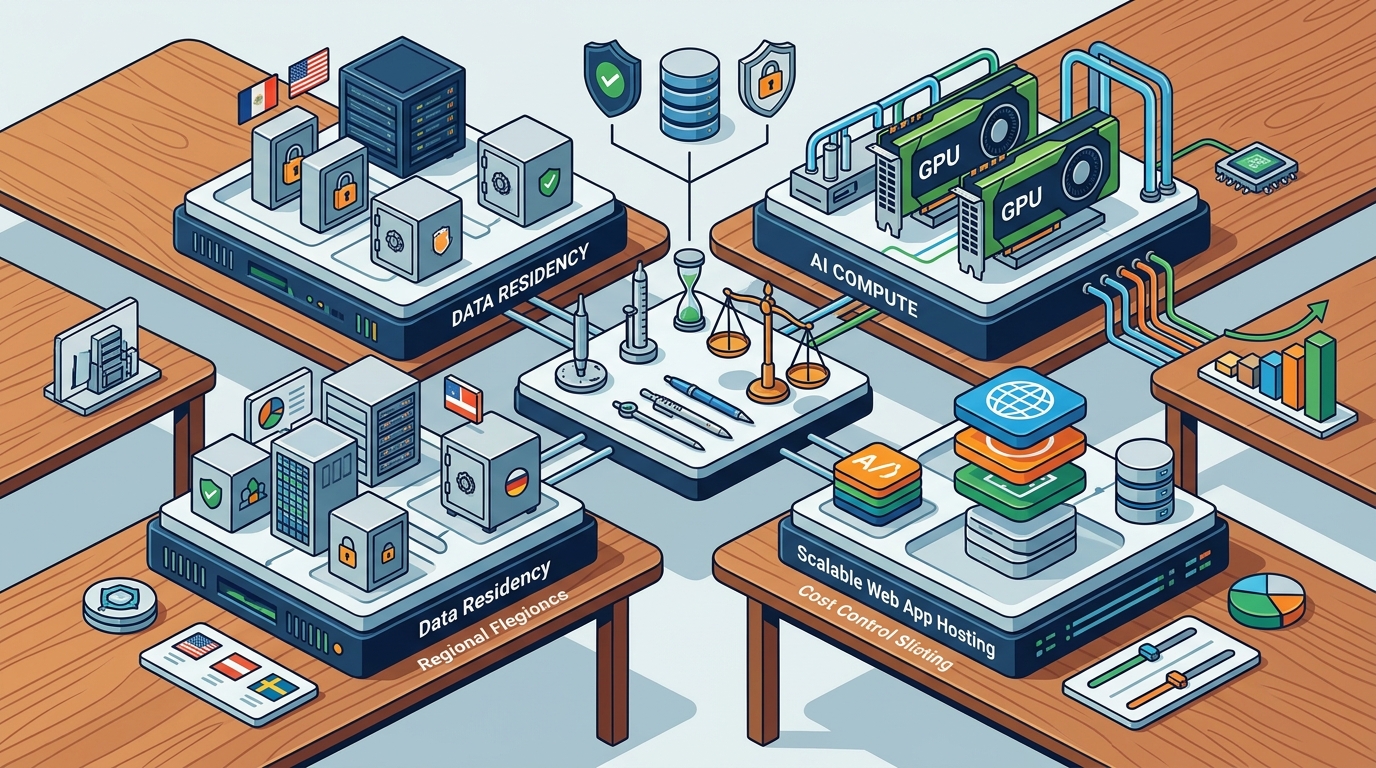
Data residency controls, identity segmentation, and support for zero-trust architecture principles are critical for regulated industries. Providers that offer granular data-location controls give you an edge when operating across borders.
If your business handles sensitive data, working with an experienced IT infrastructure partner can help you navigate compliance requirements from the start.
Scalability and Performance
Scalability is the ability of a cloud platform to increase or decrease resources in response to workload demands. The ideal provider makes it easy to scale up (add power to existing machines) and scale out (add more machines) when you need to.
Vertical, Horizontal, and Auto-Scaling
Some cloud services offer automatic scaling as a temporary response to spikes in traffic, optimizing server stress without manual intervention or downtime. Look for providers that also let you scale down to save money during quieter periods.
Performance metrics such as latency, throughput, and data-center proximity to your user base directly affect application speed and user satisfaction. If you are planning a mobile app with a global audience, distributed infrastructure is essential.
Pricing Transparency and Cost Control
Hidden transfer costs, premium support fees, and fragmented discount models create friction at renewal time. Providers with simpler billing structures now hold a real competitive advantage, especially with mid-market and engineering-led buyers.
| Cost Factor | What to Check | Risk if Ignored |
|---|---|---|
| Egress Fees | Per-GB charge for data leaving the provider | Bill shock on data-heavy workloads |
| Support Tiers | Whether premium support is bundled or extra | Slow response during incidents |
| Reserved vs. On-Demand | Discount programs and commitment terms | Overpaying for predictable workloads |
| Storage Tiers | Hot, warm, and cold storage pricing | Unnecessary spend on infrequently accessed data |
| API Call Costs | Per-operation charges for storage and services | Compounding costs at scale |
FinOps, or Cloud Financial Operations, is the practice of aligning engineering, finance, and leadership teams to bring accountability and visibility into cloud spending. Adopting a FinOps approach from day one keeps budgets predictable as you grow.
AI and GPU Infrastructure
AI-driven workloads are reshaping how teams evaluate cloud platforms. For AI workloads, confirm GPU availability, provisioning timelines, and regional capacity before committing. High-throughput storage and low-latency networking are equally crucial because model training and inference involve moving large datasets between compute and storage.
AWS, Azure, and Oracle currently lead in managed AI stacks. AWS offers Bedrock for foundation-model access and SageMaker for ML pipelines, while custom chips like Graviton4 and Trainium2 handle general and training workloads respectively.
Teams building AI-powered products can accelerate delivery by combining cloud GPU infrastructure with expert AI integration services that handle model deployment and optimization.
Integration and Developer Experience
The best cloud provider in the world is useless if your developers cannot work with it efficiently. Consider API design, documentation clarity, CLI tooling, and ecosystem integrations. A streamlined developer workflow reduces onboarding friction and operational complexity.
Compatibility with Existing Systems
Ensure the cloud service can integrate smoothly with your current infrastructure and support both technical and operational objectives without compromising security. Infrastructure-as-Code tools like Terraform and CloudFormation enable repeatable, auditable deployments.
If your team builds custom SaaS products, choosing a cloud provider with strong API documentation and managed Kubernetes support will save months of engineering effort.
Support Quality and SLAs
A provider with a history of efficiency, responsiveness, and positive user feedback is likely a good long-term choice. Research the provider's market reputation through reviews and testimonials to gain insights into service quality and customer satisfaction.
Multi-cloud strategy is now the norm for most enterprises. Cloud strategy in 2026 is no longer about choosing one provider; it is about matching workloads to the right platform. Cross-cloud management tooling exists because customers are already operating this way.
When evaluating support, ask about guaranteed response times for critical tickets, dedicated account managers, and whether 24/7 coverage requires an additional fee.
Key Takeaways
- Cloud infrastructure spending surpassed $419 billion in 2025, making provider selection a high-impact decision.
- Uptime SLAs of 99.9%+ are standard; evaluate real incident-response history, not just marketing promises.
- Compliance certifications like SOC 2, ISO 27001, HIPAA, and PCI DSS are non-negotiable for regulated industries.
- Pricing transparency matters more than headline rates; watch for egress fees, support tiers, and API call costs.
- AI and GPU readiness is now a core evaluation criterion, not an add-on consideration.
- Developer experience, including API quality and documentation, directly affects team velocity.
- Multi-cloud is the default; match workloads to platforms rather than picking a single provider.
Frequently Asked Questions
What is a cloud infrastructure provider?
A cloud infrastructure provider is a company that delivers on-demand computing resources such as servers, storage, networking, and databases over the internet. Businesses use these services to avoid large capital expenditures on physical hardware.
Which cloud providers have the largest market share in 2026?
AWS, Microsoft Azure, and Google Cloud Platform dominate, accounting for approximately 63% of the global cloud infrastructure market as of Q1 2026. AWS leads with roughly 28% market share.
How important is compliance when choosing a cloud provider?
Compliance is critical, especially for regulated industries. Certifications such as SOC 2 Type II, ISO 27001, HIPAA, and PCI DSS increasingly determine which providers make it into enterprise procurement shortlists.
What are egress fees in cloud computing?
Egress fees are charges applied when data leaves a cloud provider's network. They can cause significant bill shock for data-heavy workloads and should be evaluated carefully during provider selection.
Should I use a single cloud provider or go multi-cloud?
Most enterprises in 2026 use a multi-cloud approach, placing different workloads on different platforms. Data pipelines, regulated apps, development environments, and AI infrastructure often land on separate providers for good reasons.
How do I evaluate cloud provider support quality?
Check whether 24/7 support is included or requires an upgrade, ask about guaranteed response times for critical incidents, read user reviews, and request references from customers in your industry.
What role does AI play in cloud provider selection?
AI infrastructure, including GPU availability, managed ML tooling, and model-serving capabilities, is now a core factor. AWS, Azure, and Oracle lead in managed AI stacks for enterprise workloads.
Get Expert Help With Your Cloud Strategy
Choosing the right cloud infrastructure provider is complex, but you do not have to navigate it alone. NEXINFINITY META helps businesses architect, build, and manage cloud-native solutions from initial strategy through deployment. Contact our team today to discuss your cloud infrastructure needs and get a tailored recommendation.