

Planning to build a mobile app but unsure about the budget? You are not alone. Mobile app development cost is the single most common question founders, product managers, and business owners ask before starting a project. In 2026, the answer ranges from $15,000 for a basic app to well over $500,000 for a complex, feature-rich platform. This guide breaks down every cost factor, gives you real price ranges by complexity tier, and shows you how to get maximum value from your investment. Whether you need an iOS, Android, or cross-platform app, these numbers will help you plan with confidence.
The Quick Answer: What Does a Mobile App Cost?
Mobile app development cost is the total investment required to design, build, test, and launch a mobile application. According to industry data compiled from over 5,000 projects, the average cost of custom mobile app development sits at $171,450 in 2025-2026. However, most small-to-mid business applications fall between $50,000 and $120,000.
The range is wide because no two apps are alike. A simple informational app with five screens and no backend costs far less than a marketplace platform with real-time messaging, payment processing, and AI-powered recommendations.
Cost by Complexity Tier
Complexity is the single biggest lever on your final price tag. An app complexity tier is a classification based on the number of features, integrations, and technical requirements involved. Here is how the numbers break down in 2026:
| Complexity Tier | Example Apps | Estimated Cost Range | Timeline |
|---|---|---|---|
| Simple | Landing page app, calculator, basic catalog | $15,000 - $40,000 | 6-10 weeks |
| Moderate | E-commerce store, booking system, content platform | $40,000 - $120,000 | 3-5 months |
| Complex | Marketplace, fintech, health-tech with compliance | $120,000 - $300,000 | 5-9 months |
| Enterprise / Advanced | Super-app, multi-role SaaS, IoT integration | $300,000 - $500,000+ | 9-18 months |
These figures cover design, development, QA, and initial app store deployment. They do not include ongoing maintenance, which typically adds 15-20% of the original build cost each year. If your project leans toward custom SaaS development, expect costs at the higher end due to multi-tenant architecture and subscription billing logic.
Key Factors That Drive App Development Costs
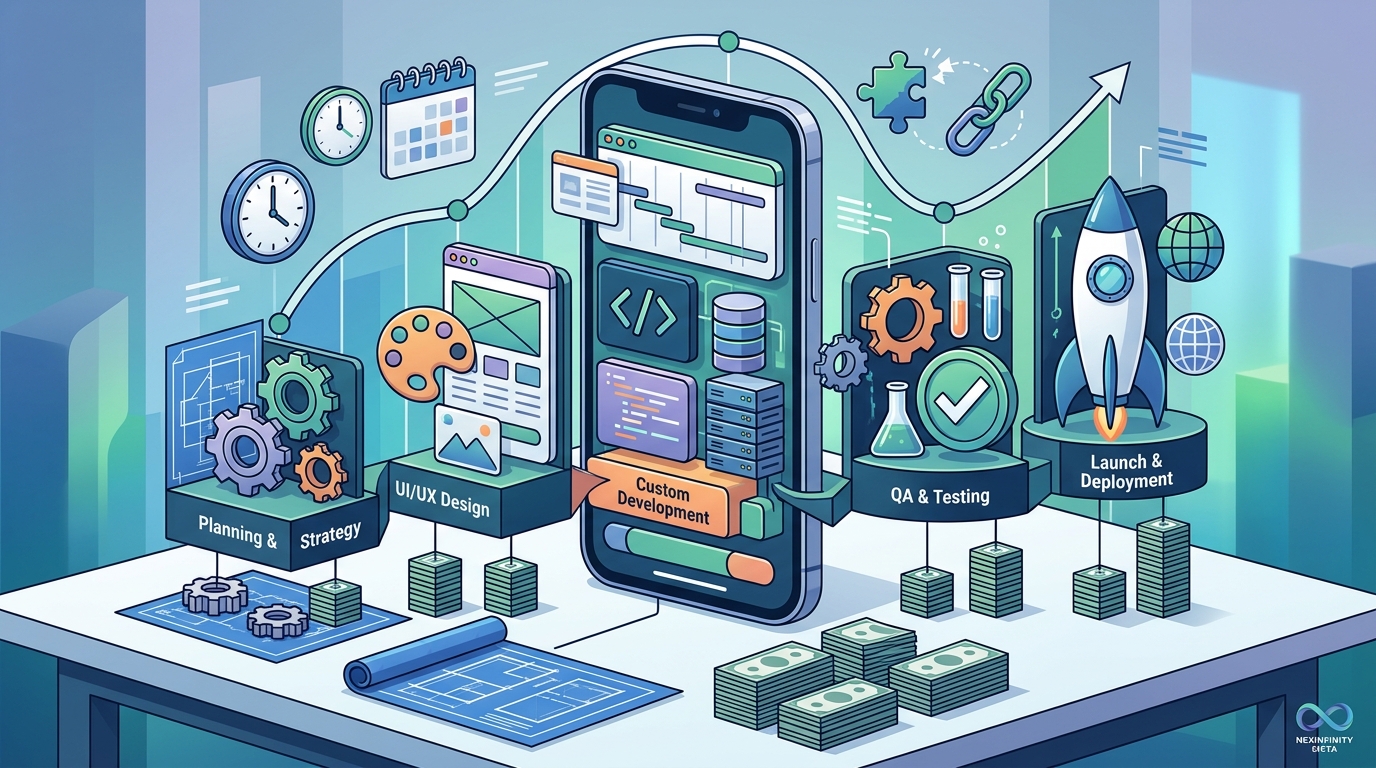
Features and Functionality
Every feature you add increases scope. User authentication, push notifications, and a basic profile system are relatively inexpensive. Real-time chat, payment gateways, third-party API integrations, and machine learning features push costs significantly higher.
UI/UX Design Complexity
A polished, custom-designed interface costs more than using pre-built UI kits, but it directly impacts user retention. Investing in professional UI/UX design early prevents expensive redesigns later. Design typically accounts for 10-20% of the total project budget.
Team Location and Structure
Developer hourly rates vary dramatically by region. North American agencies charge $150-$250 per hour, while equally skilled teams in India operate at $25-$80 per hour. According to recent agency reports, global developer rates dropped about 9-16% in 2025 as AI tools compressed delivery time.
Platform Choice: iOS vs. Android vs. Cross-Platform
A cross-platform framework is a development toolkit (like Flutter or React Native) that lets you write one codebase for both iOS and Android. This approach has matured considerably. According to Kellton's 2026 analysis, cross-platform development reduces costs by 30 to 50 percent compared to building two separate native apps.
| Approach | Pros | Cons | Best For |
|---|---|---|---|
| Native iOS | Best performance, full API access | iOS-only, higher cost | Apple-first products |
| Native Android | Largest global market share | Device fragmentation | Android-first products |
| Cross-Platform (Flutter/React Native) | 30-50% cost savings, one codebase | Minor performance trade-offs | Most business apps in 2026 |
For most business applications, cross-platform is the recommended starting point. If you also need a web presence, consider pairing your mobile app with a web application built on the same backend to maximize code reuse.
Hidden Costs Most Budgets Miss
Quality Assurance and Testing
Industry benchmarks place QA at 20-25% of total development hours. Skipping thorough testing leads to poor app store reviews and costly post-launch patches. At a blended rate of $100-$150 per hour, QA alone can account for $10,000-$30,000 on a mid-range project.
Post-Launch Maintenance
The industry standard for annual maintenance is 15-25% of the original development cost. A $100,000 app requires at least $15,000-$25,000 per year for OS updates, bug fixes, security patches, and minor feature additions.
Third-Party Services
Cloud hosting, push notification services, analytics platforms, payment processor fees, and App Store/Play Store developer accounts all add up. Budget $500-$5,000 per month depending on your user volume and cloud infrastructure needs.
How to Reduce Mobile App Development Costs
Start with an MVP. A minimum viable product targeting one platform with core features typically lands in the $25,000-$60,000 range. Validate your idea with real users before investing in the full feature set.
Use cross-platform frameworks. Flutter and React Native now cover roughly 90% of use cases, saving you the expense of maintaining two native codebases.
Leverage AI-accelerated development. Teams using AI coding assistants and automated testing can compress delivery timelines by 20-30%, translating directly into lower billable hours. At NEXINFINITY META, we use AI integration across every stage of development to deliver faster without sacrificing quality.
Choose the right partner. Working with an end-to-end team that handles design, development, and deployment under one roof eliminates costly handoffs between agencies.
Key Takeaways
- Mobile app development costs range from $15,000 to $500,000+ in 2026, depending on complexity, features, and team location.
- The average custom app costs about $171,450, but most SMB apps fall between $50,000 and $120,000.
- Cross-platform development with Flutter or React Native saves 30-50% compared to building separate native apps.
- Annual maintenance adds 15-25% of the original build cost every year.
- QA and testing should account for 20-25% of total development hours to avoid costly post-launch issues.
- Starting with an MVP ($25,000-$60,000) is the smartest way to validate your idea before scaling.
- AI-accelerated workflows can reduce timelines and costs by 20-30%.
Frequently Asked Questions
How much does it cost to build a simple mobile app?
A simple mobile app with basic functionality (5-10 screens, no complex backend) typically costs between $15,000 and $40,000 in 2026. This includes design, development, and initial app store submission.
Is it cheaper to build for iOS or Android?
iOS development generally costs slightly less than Android due to fewer device variations to test against. However, the difference is marginal. Cross-platform frameworks eliminate this concern entirely.
How long does mobile app development take?
A simple app takes 6-10 weeks. Moderate complexity apps require 3-5 months. Complex enterprise apps can take 9-18 months from discovery to launch.
What is the cheapest way to build a mobile app?
The most cost-effective approach is to start with a cross-platform MVP, partner with a skilled team in a cost-efficient region like India, and use AI-accelerated development workflows.
How much does app maintenance cost per year?
Plan for 15-25% of the original development cost annually. This covers OS compatibility updates, security patches, bug fixes, and minor feature improvements.
Should I build a native or cross-platform app?
For most business apps in 2026, cross-platform (Flutter or React Native) is the recommended choice. It covers about 90% of use cases and saves 30-50% in development costs. Choose native only if you need intensive hardware access or peak performance.
What factors increase app development costs the most?
The biggest cost drivers are app complexity, real-time features (chat, video, location tracking), third-party integrations, regulatory compliance requirements, and custom animations or UI design.
Can AI reduce mobile app development costs?
Yes. AI coding assistants and automated testing tools can compress development timelines by 20-30%. Teams that integrate AI into their workflow deliver faster at lower total cost without sacrificing quality.
Get Your Custom App Development Estimate
Every app is different, and the only way to get an accurate cost is to discuss your specific requirements. At NEXINFINITY META, our in-house team in Chennai handles everything from UI/UX design to deployment and post-launch support. Contact us with your feature list and we will provide a realistic cost range, platform recommendation, and timeline within 48 hours.