
A beautiful website that fails to convert visitors into customers is just an expensive digital brochure. In 2026, the gap between a good-looking website and a high-converting one has never been wider. With Core Web Vitals now functioning as hard ranking factors, mobile-first indexing as the default, and AI reshaping how users discover content, every design and development decision must serve a clear business goal. This guide covers the most impactful web development best practices that drive measurable conversions, whether you are launching a new project or redesigning an existing site.
Start With Mobile-First Architecture
Mobile-first design is the practice of building the mobile version of a website before scaling up to larger screens. Over 60% of global web traffic now originates from mobile devices, and Google evaluates the mobile version of your site before the desktop version through mobile-first indexing.
If your site does not perform well on smartphones and tablets, you lose both rankings and customers. A professional web development approach ensures responsive layouts, touch-friendly interactions, and fluid typography from the start.
Key Mobile-First Principles
- Use relative units (rem, %, vw) instead of fixed pixels
- Prioritize thumb-friendly tap targets (minimum 48px)
- Test on real devices, not just browser emulators
Optimize Page Speed and Core Web Vitals
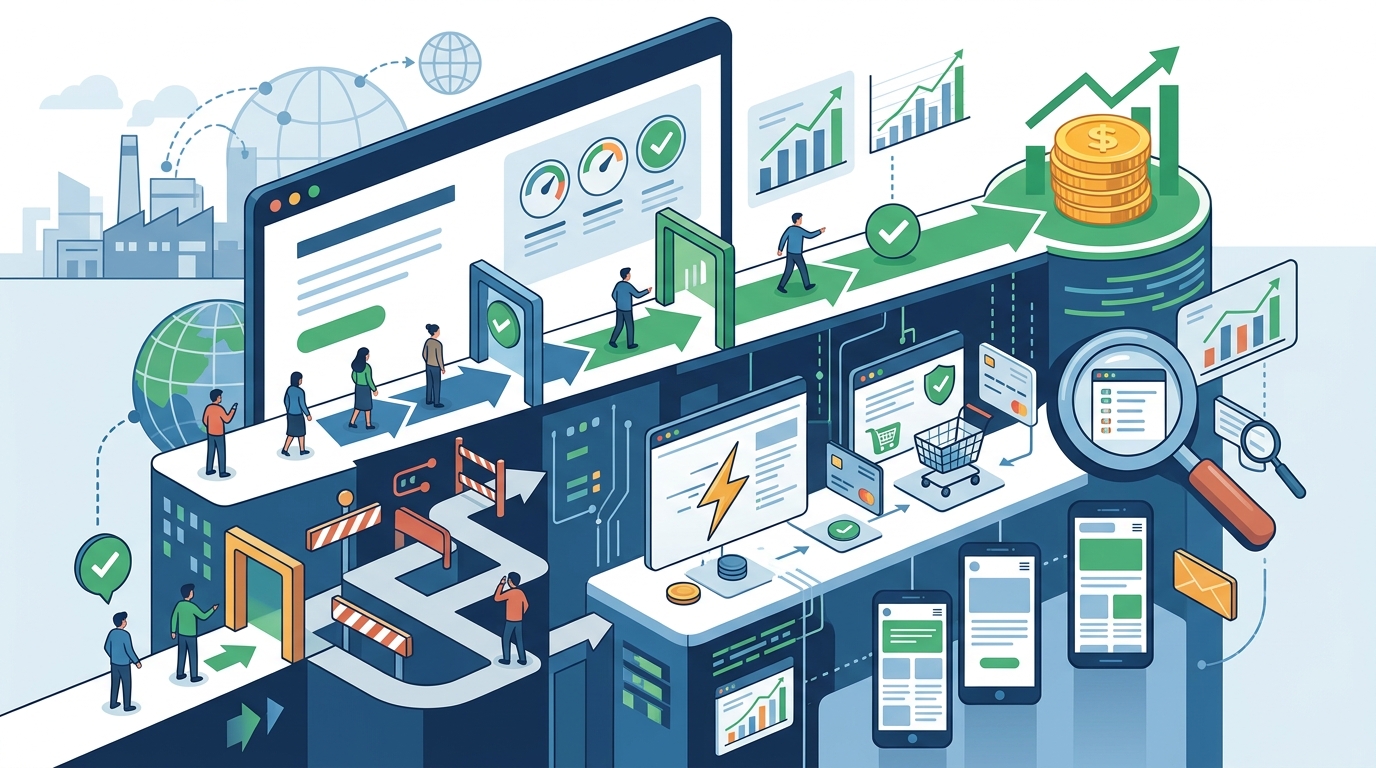
Page speed is the time it takes for your web page content to fully load and become interactive. A three-second load delay drives away nearly 40% of visitors, and most businesses never connect that lost traffic to a technical gap. Core Web Vitals, including Largest Contentful Paint (LCP), Interaction to Next Paint (INP), and Cumulative Layout Shift (CLS), are now critical ranking factors.
Speed Optimization Checklist
| Optimization | Impact on LCP | Difficulty |
|---|---|---|
| Compress and lazy-load images | High | Easy |
| Minify CSS and JavaScript | Medium | Easy |
| Use a CDN for global delivery | High | Medium |
| Enable server-side caching | High | Medium |
| Eliminate render-blocking resources | High | Hard |
Tools like the image compressor and CSS minifier from NEXINFINITY META can help you tackle low-hanging performance wins in minutes.
Design for User Experience, Not Just Aesthetics
User experience (UX) is the overall feeling and ease a person has when interacting with your website. A smooth experience leads to trust, and trust leads to conversions. High-converting websites remove unnecessary elements and focus only on what matters: clear navigation, readable typography, and logical page hierarchy.
Investing in expert UI/UX design means every screen is tested for usability, not just visual appeal. Use clear menus, breadcrumb navigation, and a logical site structure so visitors always know where they are and what to do next.
Accessibility Matters
Accessible websites outperform inaccessible ones. Following WCAG 2.2 guidelines improves usability for everyone, expands your audience, and reduces legal risk. Contrast ratios, keyboard navigation, and screen-reader compatibility are non-negotiable in 2026.
Build a Clear CTA Strategy
A call to action (CTA) is a prompt that tells the visitor exactly what step to take next. Effective CTAs use action-oriented language, high-contrast colors, and strategic placement above the fold and at natural decision points.
A landing page has one goal and one goal only: conversion. Effective landing page design for high-converting websites includes a single focused headline, one primary CTA, minimal form fields, and supporting social proof. Every page on your site should have a clear next step, whether it is booking a demo, requesting a quote, or starting a free trial.
Structure Content for SEO and AI Discovery
Search engine optimization (SEO) is the process of improving your website so it ranks higher in search engine results pages. In 2026, SEO strategy should also account for Answer Engine Optimization (AEO) and Generative Engine Optimization (GEO), because AI tools now sit between users and the websites they are looking for.
On-Page SEO Essentials
- Use one H1 per page with primary keyword
- Structure content with semantic H2 and H3 headings
- Write concise meta descriptions under 155 characters
- Add structured data (FAQ, HowTo, Article schema)
- Use descriptive alt text on all images
A strong digital marketing and SEO strategy ensures your content reaches users in organic results and AI-generated answers alike. Use tools like the meta tags generator to streamline on-page optimization.
Leverage Trust Signals and Social Proof
People will not convert unless they trust you. Trust signals include client testimonials, case studies, security badges, partner logos, and transparent pricing. According to Think with Google, users form an opinion about a website within seconds, and friction in user experience can significantly reduce conversions.
Display real results. Link to your portfolio and case studies so prospects can see the work behind the claims. A structured CRO audit typically reveals where friction sits, usually in messaging, hero structure, or trust signals before the user reaches your CTA.
Use AI-Powered Personalization
AI-powered personalization is the use of machine learning to deliver tailored content, product recommendations, and dynamic experiences to individual users. AI improves conversions through personalization, predictive analytics for identifying high-intent visitors, chatbots for qualifying leads around the clock, and automated A/B testing.
Integrating AI capabilities into your web platform is no longer experimental. Businesses that adopt these tools see measurable lifts in engagement and pipeline. The average B2B website converts between 2% and 4% of visitors into leads; even a one-point lift in conversion rate can cut customer acquisition cost by 15% to 30%.
Key Takeaways
- Mobile-first architecture is the foundation, not an afterthought. Over 60% of traffic is mobile.
- A three-second load delay costs you nearly 40% of visitors. Optimize Core Web Vitals aggressively.
- UX design and WCAG 2.2 accessibility directly improve conversion rates and search rankings.
- Every page needs a single, clear CTA with action-oriented copy and high-contrast design.
- Structure content for both traditional SEO and AI discovery (AEO/GEO).
- Trust signals like testimonials, case studies, and security badges reduce friction before the CTA.
- AI-powered personalization can lift conversions by 1%+ and reduce acquisition costs by up to 30%.
Frequently Asked Questions
What is a high-converting website?
A high-converting website is one that effectively turns visitors into leads, subscribers, or customers. It achieves this through clear messaging, fast load times, intuitive navigation, and strategically placed calls to action.
What is a good conversion rate for a website in 2026?
The average B2B website converts between 2% and 4% of visitors. B2B SaaS companies often sit closer to 1%. Anything above 4% is considered strong performance.
How does page speed affect conversions?
Slow-loading pages cause visitors to leave before they see your offer. A three-second delay can result in roughly 40% visitor loss. Google also ranks faster websites higher, making speed a dual factor for traffic and conversions.
Why is mobile-first design important for conversions?
With over 60% of web traffic coming from mobile devices and Google using mobile-first indexing, a site that performs poorly on mobile loses both search visibility and potential customers.
How does AI personalization improve website conversions?
AI personalization shows different content to different users based on behavior, identifies high-intent visitors through predictive analytics, qualifies leads via chatbots 24/7, and automates A/B testing for continuous optimization.
What are Core Web Vitals and why do they matter?
Core Web Vitals are a set of Google metrics measuring loading speed (LCP), interactivity (INP), and visual stability (CLS). They directly impact your search rankings and user experience quality.
How can I improve my website's trust signals?
Add real client testimonials, display partner and security logos, publish detailed case studies, use HTTPS, and show transparent pricing. These elements reduce visitor hesitation and encourage action.
Ready to Build a Website That Converts?
NEXINFINITY META designs, builds, and optimizes high-converting websites with AI-accelerated delivery from Chennai, India. From full-stack web development to conversion-focused UI/UX design, our in-house team handles everything under one roof. Contact us today to start your project.